The Spatial Archive: Moving Research Beyond the Page
Using spatial technology to create interactive student research archives
As part of my ongoing work with The Curiosity Project, I continuously look for innovative ways to elevate student output by embedding emerging technologies directly into academic and vocational workflows. One of the latest projects takes traditional academic research posters produced by our Oxbridge-track GCS Honours Programme students at Gower College Swansea and reimagines them entirely within a 3D digital ecosystem.
Rather than letting these high-level research projects sit on hard drives or flat physical display boards, I wanted to permanently preserve and showcase them spatially. To bring this vision to life, I collaborated with a terrific student, Tomi Oguntunde, tasking her with building a permanent virtual exhibition space using the web-based spatial platform arrival.space.
The pipeline was remarkably collaborative, after students submitted their extensive academic research posters, the program lecturers passed the assets to me. I met with Tomi to provide technical mentorship, establishing structural guidelines and providing a hands-on demonstration of arrival.space's design toolkit. From there, Tomi took full creative ownership of the spatial architecture.
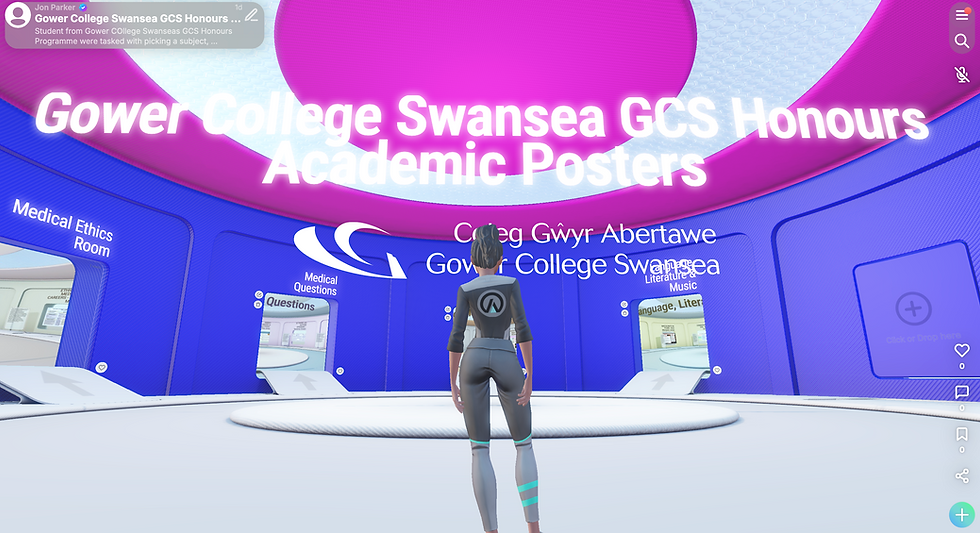
The result is a multi-room virtual gallery. Visitors land in a sleek, centralized atrium branded with the Gower College Swansea identity, acting as a gateway to dedicated thematic pavilions including Medical Ethics and Language, Literature & Music, and much more. Inside, avatars can physically navigate past interactive display wall, viewing complex research pieces l that unpack deep scientific, ethical, and socio-economic arguments. This project perfectly encapsulates how spatial computing can transform standard academic delivery into an interactive, globally accessible digital archive.
Project Gallery


