VR for Dementia Care
Exploring spatial technology for dementia care and nostalgia therapy.
The VR in Dementia project explores how immersive technology can be used as a tool for nostalgia therapy to support individuals living with dementia or mild cognitive impairment (MCI). Initially funded through Global Wales, the project began with a simple concept: using 3D scanned familiar virtual environments to trigger memory recall, promote emotional wellbeing, and maintain connection to personal identity.

As part of the early development, we created researched and tested series of different 3D scanning tools such as LUMA AI, Kiri Engine, PolyCam and Scaniverse. Students from Creative Media Production were involved in the testing of thses tools, playing a crucial part in the projects direction. See image to the left.
In October 2024, the project expanded internationally. Gower Colleger Swansea hosted Professor David Neumann from Humber College, Toronto, who visited Swansea to collaborate and share knowledge towards the global problem of dementia. During Davids visit we curated a series of 360° Photographic VR experiences and some Gaussian Splat based VR experiences based around familiar places in Swansea. These spaces were carefully demonstrated at a local dementia club with patients, family members and carers where our proof of concept received overwhelmingly positive feedback from those key stakeholders validating the project's real-world therapeutic potential.
Shortly afterward, I traveled to Toronto where we engaged with the team at Shalom Village, a residential dementia care facility. This visit deepened the research partnership by opening up a series of ethical queries and questions which students at Gower College will be taskeed with navigating and finding solutions.This will ensure thsat the project has a solid consideration and navigation of ethicasl implications whilst providing a real world scenario for students to explore the topic of research ethics. This visit also proved beneficial due to the amount of positive feedback given which provided huge ongoing scalability opportunities for the project.
In February 2025, six students from Gower College Swansea travelled to Humber College in Toronto to take part in a three-day Dementia Hackathon.
Working in interdisciplinary teams alongside postgraduate students from Social Care Work, Creative Technology, and Funeral Services programmes, they collaborated to design innovative ways spatial technologies could be embedded into dementia care environments and support the wellbeing of aging populations.
Throughout the hackathon, students explored emerging technologies, developed new digital skills, and applied them creatively to real-world challenges. Each team presented a conceptual solution as a Powerpoint and produced an AI-generated video to demonstrate their final idea, highlighting a rapid shift in their digital confidence.
The Dementia Hackathon is a clear example of how embedding emerging technologies can enhance accessibility, develop confidence across diverse learners, and support a culture of innovation that extends far beyond individual classrooms. It is a model that I intend to replicate in Gower College from September 2025.Off the back of this Hackathon, Matheus Camilleri, a student researcher from Humber College, joined the VR in Dementia project to help advance the technological development of the next stage of the work.
Matheus was tasked with creating a new proof of concept: Matheus was given access to a detailed 3D scan of my own nan’s house, captured with PolyCam as a fully explorable virtual environment. Within this environment, Matheus integrated an AI avatar based on myself, designed to resemble my appearance, replicate my voice, and draw from shared memories. The prototype was built using Unreal Engine, MetaHumans, Convai, and ElevenLabs, combining spatial technology with AI-driven interaction.
The resulting immersive experience allows users to explore a familiar home environment and interact with a responsive AI companion, blending nostalgia, familiarity, and conversation. This prototype will be trialled with my nan when she moves into a care home setting. Through this trial, we aim to explore whether revisiting a meaningful environment — combined with conversation with an AI representation of a family member — can positively affect mood, emotional wellbeing, and the transition experience into residential care.
In April 2025, the project secured £48,400 in additional funding through the Taith Pathway 2 grant, allowing us to expand and enhance our research and impact.
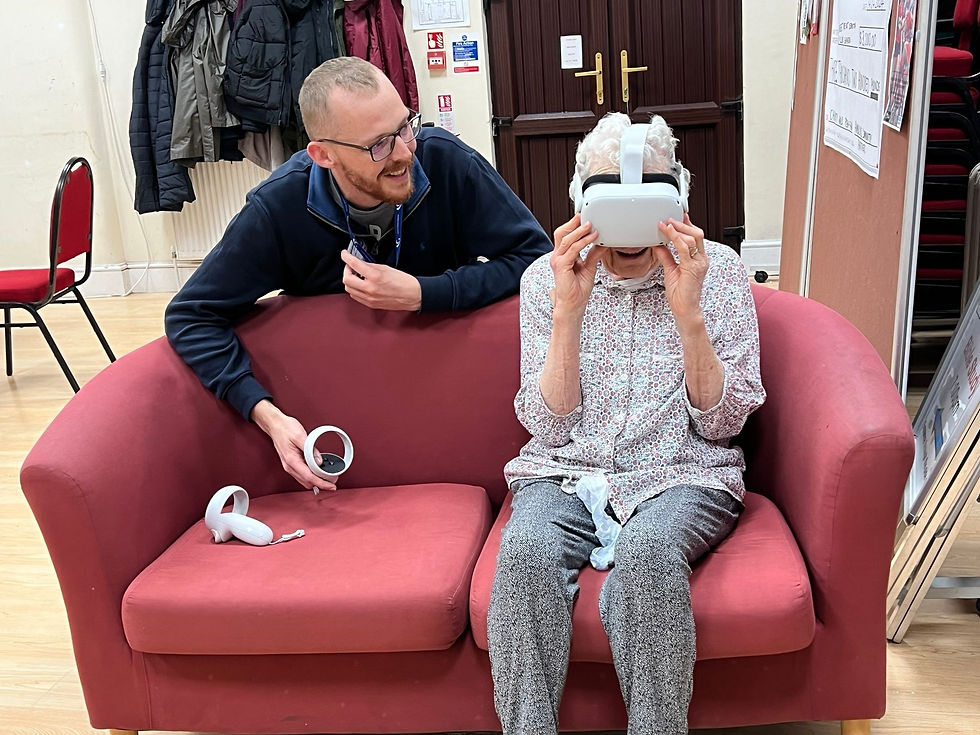
Through this next phase, we are linking with Morriston Hospital, where Health and Care students are 3D scanning real locations across Swansea to curate new VR environments that will be installed on dementia wards, see the 'Scanning Swansea' project page for more details. This work not only offers therapeutic experiences to patients but provides students with meaningful, civic-focused learning opportunities — transforming their attitudes towards learning, collaboration, and community contribution. Below is an image of the Health and Care Students experiencing VR for the first time at the start of this project!
We are also establishing formal links with Public Health Wales to align our outcomes with national health improvement priorities, exploring the potential for spatial technologies to be integrated into broader public health initiatives.
In recognition of this work, in June 2025 I presented the VR in Dementia project at the international Augmented World Expo (AWE) — showcasing how student-led innovation in immersive technologies can drive impact across health, education, and community sectors. You can read more about this here: Augmented World Expo (AWE)

As of July 2025 the project has recently incorporated significant equipment upgrades. We are pleased to announce the acquisition of the Insta360 X5, the Zoom H3-VR, and the DJI Mavic Air 3S. These additions represent a substantial leap in our capacity to produce highly realistic and engaging content.
Specifically, the integration of the Insta360 X5 and Zoom H3-VR has enabled a transition from standard 360-degree images to the creation of 8K resolution 360-degree video, complemented by spatial (ambisonic) audio. This technical advancement is crucial for delivering a more profound sense of presence and realism within the virtual experiences.

Concurrently, the DJI Mavic Air 3S has markedly improved our capabilities for 3D scanning. This drone, a considerable upgrade from the previously utilized Mavic Pro, offers enhanced specifications for superior aerial data capture. Furthermore, the project aims to acquire the DJI Mavic Mini 5 Pro upon its release, which will provide a more lightweight and consumer-oriented drone solution, diversifying our scanning applications. Thes results of out recent scans with the Insta 360 X5 and the Mavic Air 3S can be sen at this link: https://arrival.space/79440952_9439 where we’ve created a fully navigable Digital Twin of Mumbles Lighthouse. This immersive experience allows users to explore the iconic Swansea landmark in both PC and VR formats, offering a powerful tool for reminiscence and local identity reinforcement.
You can explore more on this partiular project at this link: Mumbles Lighthouse Project
With the Insta 360 X5 and the Zoom H3-VR we have curated a growing YouTube playlist of 360° VR content developed throughout the project. These experiences range from familiar Swansea locations to conceptual therapeutic environments, all designed to evoke memory, emotion, and connection.
Watch the playlist here: https://www.youtube.com/playlist?list=PLTO-5j0Khs0v9G3RKf4x6CFsYZajfHe2n
As of September 2025 it was clear that a VR Modality Matrix was needed to help educators, researchers, and care professionals better understand the therapeutic potential of different immersive formats. This visual tool maps out the various types of VR experiences (360° video, interactive environments, AI companions, etc.) against therapeutic goals such as emotional wellbeing, memory recall, and social connection.

Throughout September and October 2025, the project turned its focus toward the critical intersection of technology and patient safety. In a series of workshops with the Gower College Health Academy, students engaged in rigorous discussions to identify the potential risks of technology-enhanced care. These sessions moved beyond theory, challenging students to map out mitigation strategies for risks such as VR withdrawal, social isolation, and frustration with the lack of physical surroundings.
The students’ work was solution-oriented; they proposed mitigating these risks by incorporating multisensory props, such as textured surfaces or scents to bridge the gap between the virtual and physical worlds. They also emphasized the importance of involving family members to build "positive patient memory profiles," ensuring that experiences trigger comfort rather than unwanted memories. Concurrently, Health Academy students began formulating specific interview frameworks for caregivers and patients, ensuring that future VR content is deeply personalized and relevant to the individual.
To support the project's growing complexity, we recruited volunteers from the Gower College Swansea Honours programme (Oxbridge candidates). These students played a pivotal role in facilitating a visit from NHS Psychology staff, who came to evaluate the technology. This event allowed students to collect valuable qualitative data, capturing the immediate thoughts and feelings of healthcare professionals during and after their VR experiences. This collaboration not only provided us with professional insights into the potential uptake of this technology but also gave students a platform to hone their research skills and gather data for the opinion piece that these GCS honours students will be writing.
In November, the partnership with Humber College reached a new milestone with a visit from four students and two faculty members: our long-term collaborator Professor David Neumann and also Proffessor Sarah Connelly, who brings critical nursing expertise to the project. The visiting student cohort represented a true interdisciplinary mix, combining Technical Artists with students with backgrounds in Nursing and Recreation.
The week was defined by immersive field research. We met with Kayleigh Phillips from Dementia Friendly Swansea, who emphasized that empathetic listening and support must take precedence over simple signposting, highlighting VR's potential for carer respite and combating social isolation. We also visited the University of Wales Trinity Saint David to test their immersive room. This experience shifted our perspective, suggesting that LED walls might offer a "gentler," semi-immersive alternative to full headsets for certain patients. Beyond these site visits, students dedicated significant time to collaborative ideation for their upcoming research piece. They critically reviewed existing literature while simultaneously processing and synthesizing the primary data gathered from our engagements with Dementia Friendly Swansea and the UWTSD Immersive Room, ensuring their findings were grounded in both academic rigour and real-world insight.
Looking Ahead: This intense period of collaboration is culminating in a significant academic achievement. Six Gower College Honours students (aged 16) are now set to be published as co-authors alongside the Humber team in the Journal of Innovation in Polytechnic Education (JIPE). Whether through an opinion piece or original research (time will tell whch route we take), this publication will document our findings on student-led innovation in dementia care, further validating the project's impact on the global stage.